







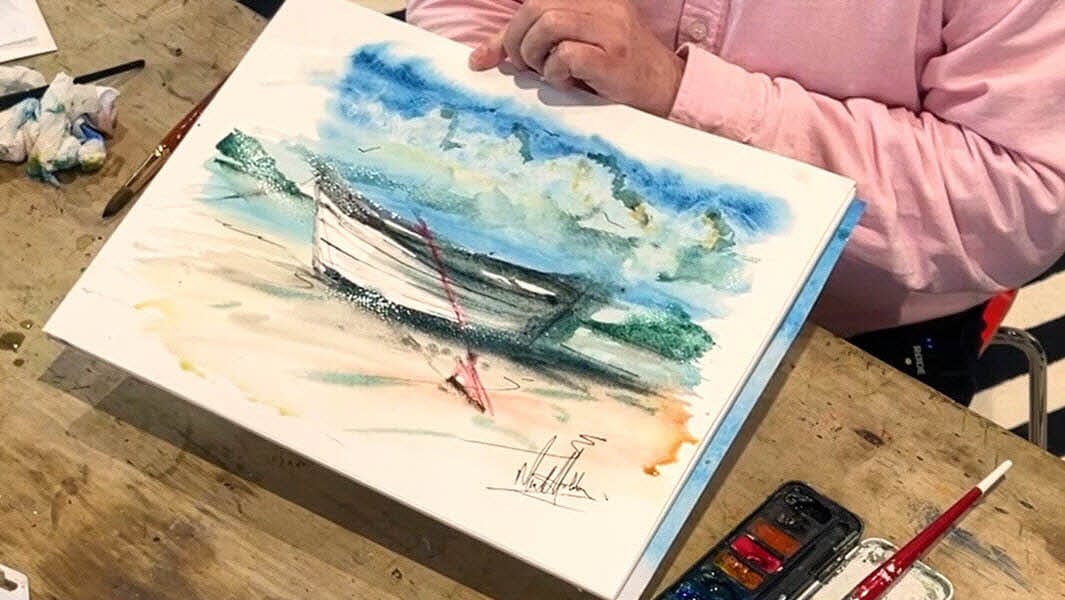
This art tutorial demonstrates how to paint boats in watercolour. The artist, Mark Holden, provides a step-by-step guide to painting this simple landscape scene of a boat on a beach and focuses on simple watercolour methods, colour mixing, tonal variation, and compositional basics to help beginners achieve an impressionistic effect.
Watch the video below but remember to get yourself a fresh cup of tea before you start watching – it’s a 19-minute video and you’ll learn lots from Mark if you stay until the end : )
Key Concepts and Techniques from this art lesson
Paper choice:
- Uses cold pressed watercolour paper for texture, allowing for interesting effects.
- Mentions future exploration of texture techniques (e.g., salt, cling film).
Basic watercolour techniques:
- Dry on dry: applying pigment on dry paper for sharper edges and details.
- Wet on wet: applying pigment on wet paper to create soft blends and tonal gradients.
- Pen and wash: combining fine liner pen drawing with watercolour washes (covered in future lessons).
How to paint a boat in watercolour:
- A simple method is to create a boat shape using lamp black and sketch an elliptical figure-of-eight shape. This creates perspective of the boat.
- Painting the boat details – brown and black mix for shadows, individual planks, and tonal modeling on dry paper.
- Dry brush work used to paint boat planks and shadows sharply.
- Loose, pale lines simulate clinkerboard panels on the boat.
- Pen detailing to reinforce the boat’s shape.
Setting up composition:
- Blue wash to establish horizon in the seascape at eye level behind boat.
- Cloud creation – apply water first, then ultramarine blue; blotting for clouds; adding yellow ochre shadows.
- Basic landscape elements: sky, boat, water, sand, and distant headlands or rocks.
Colour mixing and application:
- Primary blues: cerulean blue (mid-blue) and ultramarine blue (deep blue) used for sky and water.
- Use of yellow ochre to add warm shading and cloud shadows.
- Mixing green tones with blue to create typical west coast turquoise watercolours.
- Adding chinese white to lighten tones and create subtle variations.
Building tonal contrast:
- Emphasises the “three C’s”: Composition, Contrast, and Convergence (point of interest).
- Uses tonal layering to balance highlights, midtones, and shadows.
- Shadows applied with lamp black mixed with ultramarine blue for deep, inky darks.
- Highlights and shadows help model the boat’s shape and suggest light direction (light from left).
Painting details:
- Foreground sand painted with diluted yellow ochre and copper tones to suggest rocks and texture.
- Shadows of the boat on sand created with wet-on-wet washes for softness.
Colour lifting and blotting:
- Demonstrates how to lift paint with a clean, damp brush or tissue to lighten areas or create cloud shapes.
- Using tissue to blot excess pigment to soften intensity and create texture.
Enhancing the scene with pen:
- Adds fine pen details for surf, boat edges, and texture.
- Creates a red oar on the boat as a deliberate point of interest to draw the viewer’s eye.
- Mark always draws three birds in the sky as part of his personal signature.
Additional tips:
- Watercolour is spontaneous – encourages loose, quick work to develop style.
- Avoid muddy colours by working slowly and allowing drying time.
- Use masking tape for clean edges (not used in this tutorial).
- Can use multimedia (gouache, acrylic) to add highlights later, though purists may object.
Conclusion & Your Next Adventure?
In this tutorial artist Mark Holden provided a practical, encouraging guide on how to paint boats in watercolour. Hopefully it has given you more confidence.
What’s next – would you like to find out more about a Painting Holiday where you and a small group can learn from experienced art tutors like Mark? A whole week to focus on your art whilst away from the daily distractions of life back home. You’ll have time to paint and also have time to relax, go on excursions and make new friends.
Previous Lessons in this series:
More information on the earlier lessons in this series can be found at:
Part 2 – Watercolour paints and colour mixing.
Part 1 – Getting started with watercolours.
Join the Discussion