








This art lesson is on creating a simple watercolour landscape painting, specifically focusing on a seascape and beach, in under 15-minutes. It is based on one of Mark Holden’s favourite locations, Iona on the West coast of Scotland.
Professional artist and regular Art tutor here at Flavours, Mark aims to teach how to use watercolour paints effectively whilst building confidence, and achieving satisfying results. He emphasises straightforward techniques, practical use of brushes, layering glazes, and managing water and pigment to create depth and texture.
Watch the video lesson below but remember to get yourself a nice cup of tea before you start watching – it’s a 12-minute video and you’ll learn more if you stay until the end!
Step-by-Step Process – painting a West Coast Sky & Beach landscape
1. Preparation:
Wet the paper with a light blue wash using a large brush.
2. First Glaze:
Apply ultramarine blue glaze over the wet paper, creating natural gradients.
3. Sky and Clouds:
Add layers of blue and turquoise; paint clouds near horizon smaller to create perspective.
4. Horizon and Waves:
Define the horizon with a darker line and add subtle wave details along the shoreline.
5. Land and Path Details:
Use turquoise to show water-land transition; paint paths or roads with brush “writing.”
6. Final Touches:
Add small details and refine shapes. Adjust tonal values to create depth and clarity.
Key Concepts and Techniques
Objective:
To help learners create a simple landscape/seascape painting with confidence using watercolour.
Materials:
- Three types of brushes: dagger, special wash, and flat – each serve distinct purposes like writing detail and broad washes.
- Watercolour paints, with emphasis on colours like ultramarine blue and turquoise.
- Paper in A4 size, used in a landscape format to facilitate easy composition.
Process Overview:
- Start by wetting the paper with a light wash of blue to establish the base.
- Use glazes (layers of transparent colour) to gradually build up the painting, letting each layer dry before applying the next to avoid colour bleeding and distortion.
- Use water control – balancing the amount of water and pigment on the brush/paper is essential for effective glazing and texture control. Excess water can be easily removed with tissue to correct mistakes or lighten areas.
- Paint the sky with layered blues and add clouds near the horizon to create perspective; clouds appear smaller towards the horizon.
- Define the horizon with a slightly darker line and add subtle indications of breaking waves along the shore.
- Introduce turquoise hues to depict transitions between water and land, enhancing the natural look of the seascape.
- Incorporate elements like rocks and paths leading into the scene to add depth and visual interest.
- Use “writing” techniques with brush strokes to simulate details such as trees or texture in the foreground.
Artistic Principles:
- Gradual layering and glazing allow for controlled tonal variation and depth.
- Water control is key to managing the paint’s behaviour on the paper.
- Perspective is achieved by decreasing the size of elements (e.g. clouds) closer to the horizon.
- The balance of wet and dry areas is crucial to prevent muddiness and maintain clarity.
Timeframe:
Your initial painting can be completed in about 15 minutes, focusing on simplicity and speed to build confidence without being too complicated.
Summary
In this “under 15-minute” art lesson Mark presents a simple, repeatable approach to watercolour seascapes that builds foundational skills in brush handling, water management, and glazing techniques.
It encourages embracing a quick and confident painting style while understanding essential watercolour principles. The method is designed to be accessible and effective, serving as a stepping stone for more complex watercolour projects in the future.
The next lesson in the series focuses on painting a Tuscan landscape and continuing to grow your watercolour painting skills.
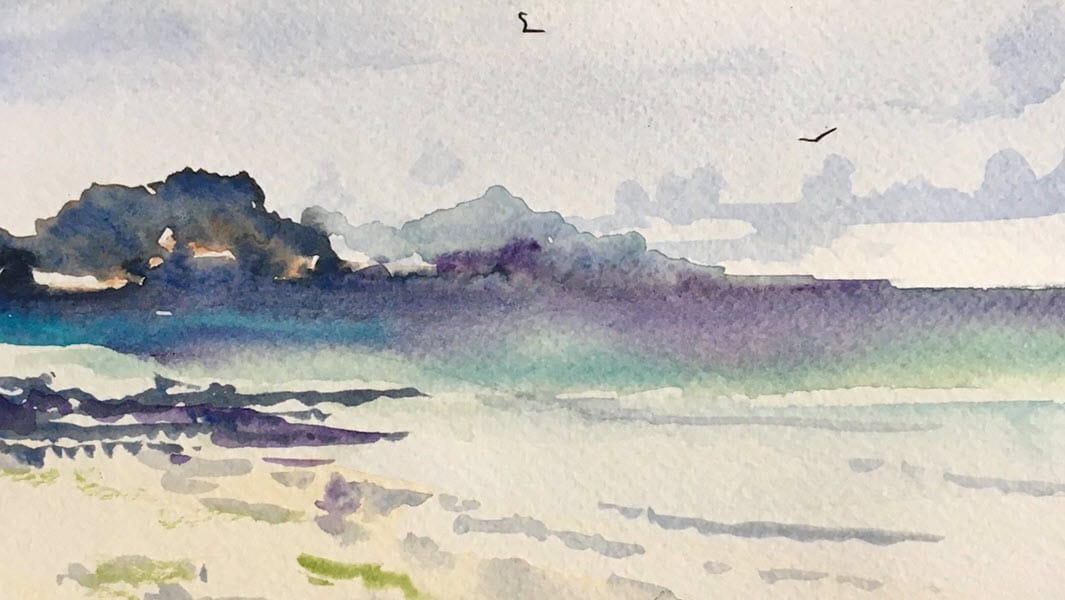
Iona Beach Scene & Landscape in Watercolour by Mark Holden.
Join the Discussion