








In this lesson (part 2 of 3), Mark Holden, Professional Artist and Tutor gives you an introduction to choosing the best watercolour paints for beginners, basic colour theory and how to start how to mix watercolour paints on the palette or plate.
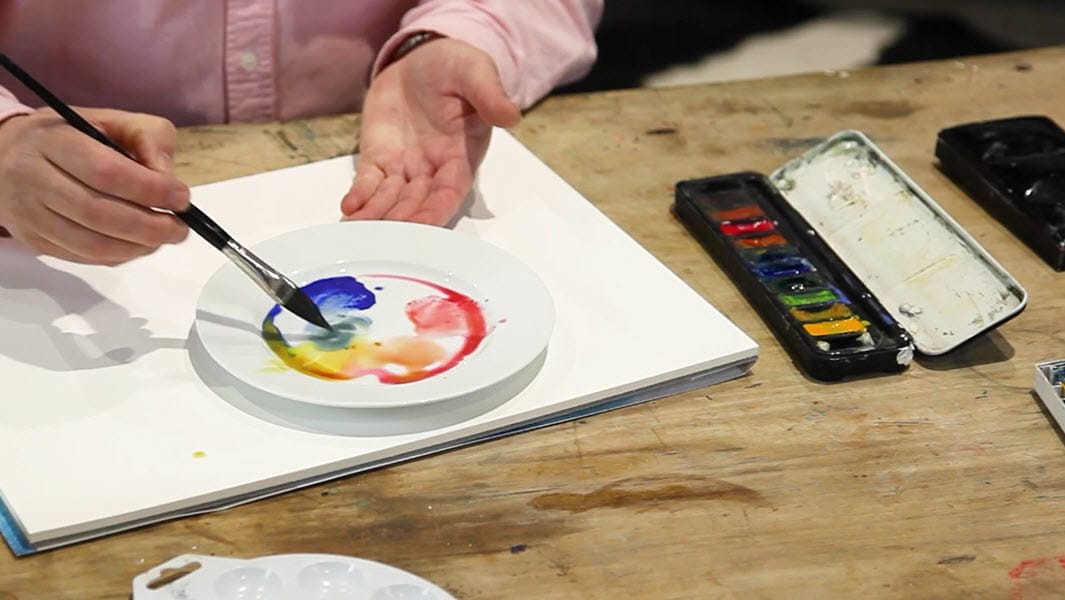
Watch on YouTube – it’ll be well worth 6-minutes of your time!
Key Insights and Concepts:
1. Confidence and Practice:
Watercolour painting can seem daunting initially, but confidence grows with consistent practice using brushes, paper, and paints.
2. Paint Boxes and Palettes:
Mark’s recommendations on the best watercolour paints for beginners:
- Beginners can start with basic travel kits that include primary colours (reds, blues, yellows) and some secondary colours.
- Paint sets vary in size: smaller kits with about 10-12 colours are sufficient initially, while larger sets can have up to 32 colours to avoid frequent mixing.
- Familiarity with a particular palette improves comfort and technique over time.
3. Colour Mixing Fundamentals:
Mark’s recommendations on how to mix watercolour paints:
- Beginners are encouraged to experiment with colour mixing gradually, starting from a few basic colours and expanding as confidence grows.
- The intensity and tone of mixed colours depend on the pigment quantity and ratio.
- Colour mixing can be done on the palette or directly on paper, with the latter allowing natural blending effects.
- Primary colours: Red, Blue, Yellow.
- Mixing primary colours creates secondary colours:
- Red + Yellow = Orange
- Blue + Yellow = Green
- Red + Blue = Violet (Purple)
4. Colour Wheel Concept:
Mark introduces a basic colour wheel of primary and secondary colours to help understand and predict colour mixing outcomes.
5. Brush and Water Handling Tips:
- Use clean water and plenty of tissue paper to rinse brushes between colours to avoid accidental mixing.
- Having multiple water beakers is recommended since water becomes tinted with paint over time but can still be used effectively.
- Loading the brush with the right amount of paint is crucial; too little paint results in very transparent washes, especially in warm environments.
Watch the video and please do leave us a comment at the bottom here (or on youtube if you click through to watch it there!)
Conclusion
This video session with painting tutor Mark Holden gives a foundational understanding of watercolour materials and colour mixing principles. It highlights the importance of practice, material familiarity, and basic colour theory as stepping stones to more complex watercolour techniques.
The next lesson in the series focuses on painting a boat and beach scene and continuing to build your foundational watercolour painting skills.
Join the Discussion