






In under 15-minutes this art lesson focuses on creating a simplified, evocative watercolour scene inspired by Venice’s Grand Canal, using negative painting and selective detail to let the viewer’s eye complete the image.
Professional artist Mark Holden (one of the Art Tutors here at Flavours) demonstrates how to suggest architectural forms and light without fully rendering every element, encouraging a loose, expressive style grounded in composition and tonal balance.
The aim is to use tonal contrast and compositional restraint to capture the essence rather than the exact likeness of the place. This is an excellent approach for artists looking to develop a fresh and expressive style in urban landscape painting.
Imagine yourself painting in Venice as you watch the video below – it’s a 14-minute video and you’ll learn more if you stay and watch the full lesson : )
Step-by-Step Process for painting the Venice Grand Canal in watercolour
1. Sketch main domes using simple curves; leave some parts unpainted for negative space.
2. Mix deep brown (burnt umber + ultramarine) for shadowed sides of domes and buildings.
3. Add columns and rooflines with dark tones to define architectural shapes.
4. Sketch windows and facades lightly while painting to integrate composition and detail.
5. Apply pale washes for distant buildings and canal, preserving light areas.
6. Introduce warmer rusty orange tones for shadows on water and roof tiles.
7. Paint canal water using cerulean blue and green, leaving white patches for sunlight.
8. Add secondary blue tones wet-in-wet for texture and variation in water.
9. Use small brush for architectural details: windows, archways, balconies, pontoons.
10. Paint gondolas and mooring poles with lamp black; add gondoliers as simple silhouettes.
11. Place a bright red accent on gondola covers to attract viewer attention.
12. Add bird shapes in the sky and always remember to sign your work!
Key Techniques and Concepts
Negative Painting (Reverse Painting):
Mark deliberately leaves parts of the paper unpainted (such as the sky and parts of domes), allowing the white empty space of the paper represent the sky. This negative painting technique relies on the viewer’s eye to fill in missing details, creating a sense of depth and atmosphere without overworking the scene.
Light and Shadow Direction:
Light is suggested as coming from right to left. This informs how shadows are painted:
- Left side of domes and buildings is shadowed.
- Right side is often left unpainted or lighter to represent light.
Simplification Through Suggestion:
Instead of detailed rendering of complex architectural features, Mark uses simple curves, brush dabs, and tonal washes to imply:
- Domes.
- Columns.
- Rooflines.
- Windows (suggested by dabbing the brush sideways).
- Archways and balconies (typical Venetian architectural features).
Layering and Tone Variation:
Multiple washes and tones are layered to create depth:
- Initial washes are pale and light.
- Secondary tones (mixed with lamp black, ultramarine, or burnt umber) add shadow and detail.
- Warmer tones (rusty orange, terracotta with touches of red and yellow) suggest sunlight, roof tiles, and reflections on water.
- Layered tonal washes and minimal brushwork can effectively convey complex architectural features without over-detailing.
- Using warm colours in shadows and reflections adds vibrancy and depth to the scene.
Capturing the Canals in Venice:
The canal water is painted with light washes of cerulean blue mixed with green, leaving white patches to represent sunlight sparkles. Ripples and reflections are suggested by slight tonal variations and brush flicks.
Foreground Elements:
Selective detail, such as gondola finials and mooring poles, provides cultural context and visual interest. The gondolas and mooring poles are painted with minimal detail but a clear shape:
- Paint the Gondolas using long, narrow curves in one stroke.
- Add Signature finials (the ‘fero da próva’) onto the gondolas, which serve as iconic markers.
- Add the gondoliers as simple silhouettes formed by small brush dabs.
- Paint mooring poles as vertical lines with some angled to create visual interest and lead the eye into the scene.
Composition Approach:
The painting is centered on the middle of the paper, with significant negative space left around to frame the scene and focus attention.
Final Details and Highlights:
- A small bright red accent on gondola covers or seating adds a focal point.
- Three simple lines representing birds flying in the sky add subtle interest to the otherwise plain negative space.
Conclusion & Your Next Adventure?
This final tutorial in the series showcases a loose, impressionistic approach to cityscape painting, demonstrating how to balance detail with suggestion and how to use negative painting to create a light-filled scene of Venice in watercolour.
What’s next – would you like to continue building your watercolour painting skills? Find out more about a Painting Holiday where you and a small group can learn from experienced art tutors like Mark. A whole week to focus on your art whilst away from the usual distractions of life back home. You’ll have time to paint and also have time to relax, go on excursions and make new friends.
“Mark, as always is very enthusiastic about his art and loves to share it with us. He helped us to think about other painting techniques and gave us the confidence to try them. Always available with a teaching session, he would also give us his individual attention and help us to see how we could improve our individual pieces of work.”
Cate
“Our tutor Mark Holden was wonderful. He was constantly positive and entertaining. He was not only a great teacher he kept the group going with humour and enthusiasm. I feel I have learnt a lot but also found an interesting way to travel with like minded people. I enjoyed all the trips . Both for art inspiration and local history.”
Karen
Previous lessons in this landscape & cityscape series:
More information on the earlier lessons in this “in under 15-minutes” series can be found at:
Course Intro on painting landscapes and cityscapes.
Part 1 – Painting a West coast beach scene in watercolour.
Part 2 – Painting a Tuscan landscape in watercolour.
Part 3 – Painting a Highland cottage in watercolour.
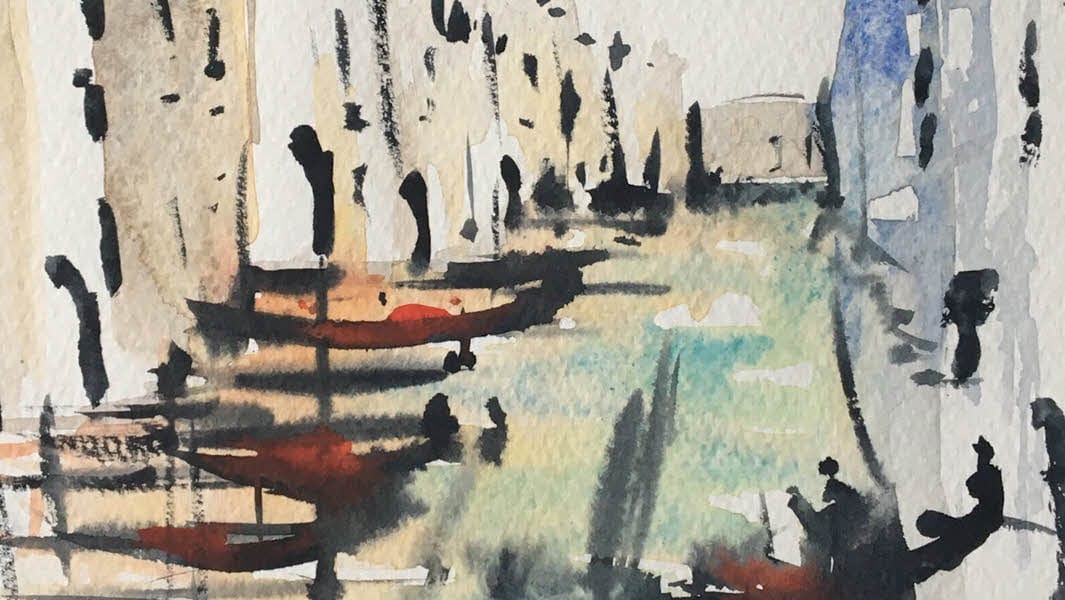
The Venice Grand Canal in watercolour by Mark Holden.
Join the Discussion