








In under 15-minutes this watercolour lesson shows you how to create a simple impressionistic watercolour painting of a Highland cottage nestled in a Scottish glen using basic washes and layering.
Watch the video below but get yourself a wee cup of tea before you start – it’s a 12-minute video and you’ll learn more if you stay and watch the full lesson : )
Step-by-Step Process for painting a Highland Cottage and Landscape
1. Creating the Sky & Clouds in watercolour:
- Begin with a blue wash from the top of the page to represent the sky. Use ‘wet-in-wet’ glazing to add a second, darker blue tone, enabling natural blending and two-tone depth.
- Form cloud tops by gently manipulating the wash with brush strokes, creating uneven ridges.
- Add shading to the undersides of clouds using diluted blue tones. Employ different brushes (flat and dagger-tip) to shape and soften cloud edges.
- Keep the sky simple and build confidence progressively; complexity can increase as your experience grows.
2. Painting the Highland Cottage:
- Focus first on the roof, mixing lamp black with Chinese white to create a slate grey tone.
- Paint the roof while leaving small white gaps (negative painting) to simulate roof lights.
- Mark establishes the light source as right to left, shading chimney pots accordingly.
- Avoid painting the gable directly to preserve the whitewashed effect of the cottage walls.
- Create outlines for roofs, chimneys, and gables with subtle tonal variations.
3. Painting the Scottish Landscape and Foreground:
- Apply a green wash for the garden or field in front of the cottage, introducing multiple greens for variation.
- Add a secondary mound with yellow ochre to create a sense of perspective and depth.
- Include a small red barn roof (terracotta tone) in the foreground, typical of the region.
- Paint windows, doors, and structural details with careful shading to imply depth and recess.
4. Applying Details and Finishing Touches:
- Use wet-in-wet shading for small window panes and door recesses with a fine brush.
- Add variation on roof tiles by layering washes.
- Introduce landscape elements, a hedge row and silhouetted trees, using darker blues for shadow.
- Create a fence in the foreground with angled posts and subtle shadow lines to lead the viewer’s eye into the scene. Use flicking techniques to add wire to the fence.
- Balance the scene with small dabs of red to highlight chimney pots and other points of interest.
- Apply shading consistently, respecting the light source, to add depth (e.g. shadows under eaves, on trees, and on the landscape behind the cottage).
Artistic Principles Used
- Negative Painting: Utilising the white of the paper to represent highlights or light areas rather than painting white paint. Leveraging the white of the paper enhances natural highlights without overworking the painting.
- Wet-in-wet Technique: Applying additional colour glazes while the base wash is still wet to create smooth blends and tonal variations.
- Perspective and Scale: Using diminishing sizes of elements (e.g., smaller chimney in the distance, lower clouds) to convey depth.
- Light Direction: Using a consistent light source from right to left guides shading and highlights as well as creating depth and enhancing the three-dimensional effect.
- Impressionistic in Style: Focus on suggestion rather than precise definition.
- Expressive Detailing: Small, impressionistic details (e.g., flicks for fence wires) to convey realism.
Summary
In under 15-minutes Mark created a simple impressionistic watercolour painting of a Highland cottage that captured the essence of the scene using straightforward techniques.
The next lesson in the series focuses on creating a watercolour of the Venice Grand Canal and continuing to build your watercolour painting skills.
Other Lessons in this landscapes & cityscapes series:
More information on the earlier lessons in this series can be found at:
Course Intro on painting landscapes and cityscapes.
Part 1 – Painting a West coast beach scene in watercolour.
Part 2 – Painting a Tuscan landscape in watercolour.
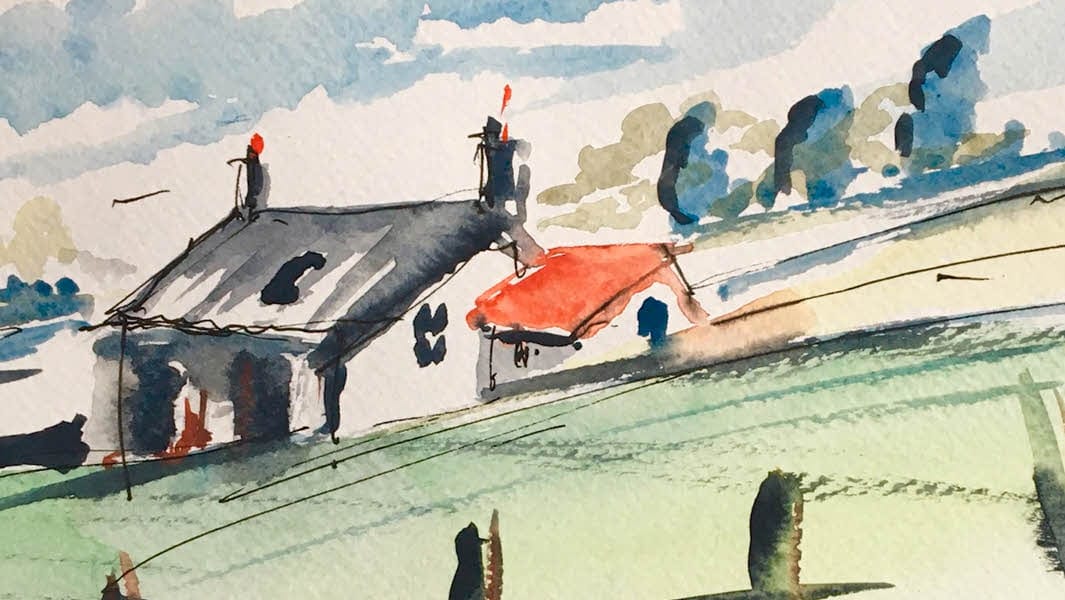
Highland Cottage in watercolour by Mark Holden.
Join the Discussion