








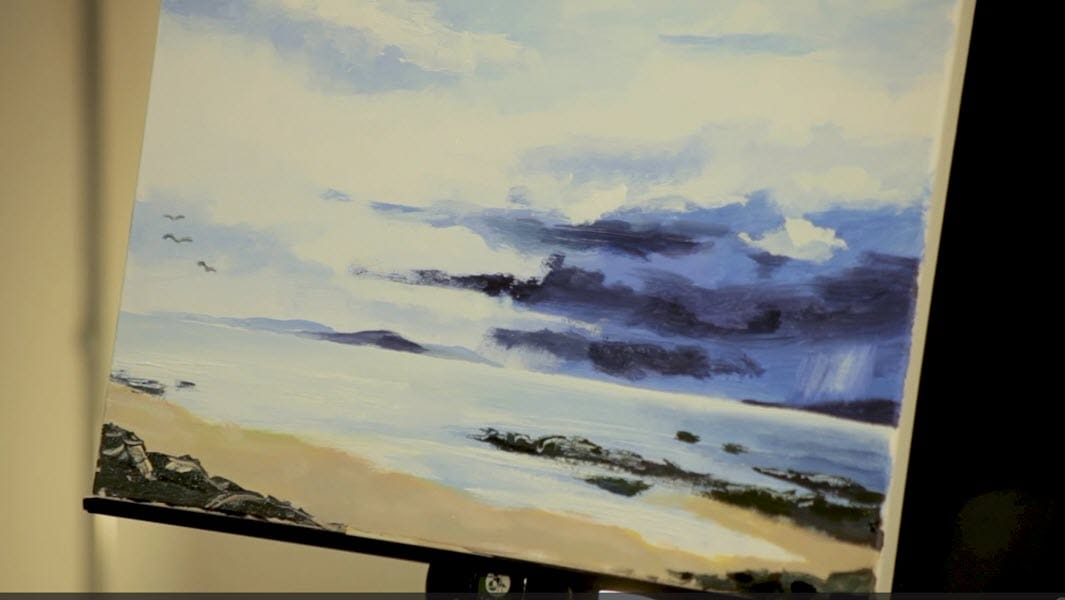
This video, the third in a series by professional artist Douglas Matthews, offers a practical and encouraging guide to painting the sea using acrylics. The focus is on acrylic painting techniques for beginners, emphasising fun and experimentation.
Watch the video below but please remember to get yourself a pot of tea before you start watching – it’s a 19-minute video and you’ll gain lots of tips from Douglas if you watch it to the end : )
Key Techniques when Painting from the Sea to the Land
1. Horizon Line Techniques
- Use masking tape to ensure a perfectly straight, sharp horizon line. It is a great way for beginners to achieve clean horizon lines without the need for complex drawing skills.
- Keep horizon lines consistent on both sides to avoid imbalance. Adjustments to the horizon line can be made easily by repositioning the tape.
2. Applying Acrylic Paints when painting seascapes
- Use varying paint thickness – thin washes in some areas and thicker paint applied with a palette knife in others.
- Use brushes and palette knives to create texture, such as ripples in water.
3. Colour Mixing and Effects
- Mixing complementary colours helps create more natural and appealing tones.
- Use primary colours mixed with white and water to create natural tones.
- Combine complementary colours to tone down brightness and create softer, more natural sand colours.
- Mix colours to create varied tones and textures in sand, water, and rocks.
- Use darker mixes to add depth and shadow, especially for rocks.
Paint colours used in this painting:
- Cadmium Red + Cadmium Yellow – Base colours for sand and warm tones
- Cobalt Blue + White – Water and sky base colours, lighter areas
- Prussian Blue + Ultramarine – Darker water shadows and ripples
- Purple (mixed with yellow) – Toning down bright yellows for softer sand.
- Alizarin Crimson + Cadmium Yellow + Prussian Blue – Darker shades for rocks and shadows.
- White – Highlights, waves and light areas.
4. Painting the Landscape Components
- Sky: Painted first, with attention to light and shadow reflecting in the water below.
- Water & Sea: Horizontal brush strokes help to mimic the natural flow and reflections. Create ripples using brush edges and palette knife scraping.
- Sand: Use warm tones, vary by mixing reds, yellows, and purples to achieve a natural, undulating look.
- Rocks: Use darker shapes with flattened bases to suggest distance; texture and add highlights by scratching and palette knife work.
- Clouds: Adjust by adding or softening shapes during the painting process to maintain balance and interest.
5. Take an Expressive Approach
- It’s about expressiveness over photorealism, don’t worry about precise drawing.
- Play with the painting during the process, such as altering clouds or water reflections.
- Use scraping and wiping techniques to remove or soften unwanted areas.
- Remember you can paint over and start again if it isn’t going the way you want.
6. Extra Tips
- It’s iterative; jump between different areas (sky, water, sand) to balance the composition.
- Acrylic painting allows for layering, scraping, and reworking, making it forgiving and suitable for beginners.
- Use a fine brush (or brush edge) to add small details, such as seagulls.
Conclusion & Next Steps
Painting the sea with acrylics is about creative application of paint and this lesson provides insights into colour mixing, brushwork, and layering techniques that develop seascapes and how the waves arrive at the land. Art tutor and professional artist Douglas says “don’t be afraid to modify elements when painting the sea – art is about enjoyment – there is no pressure to produce a perfect final piece. We are all learning and on a journey to become better painters.”
In the next part of the series Douglas will show you how to paint trees and a lovely woodland scene.
Previous Lessons in this series:
More information on the earlier lessons in this series can be found at:
Part 2 – Painting the sky and clouds in acrylics
Part 1 – Choosing paints, brushes and materials
If you’re enjoying these lessons with Douglas then please do let us know, perhaps leave us a comment below or email us at info@flavoursholidays.com.
Join the Discussion